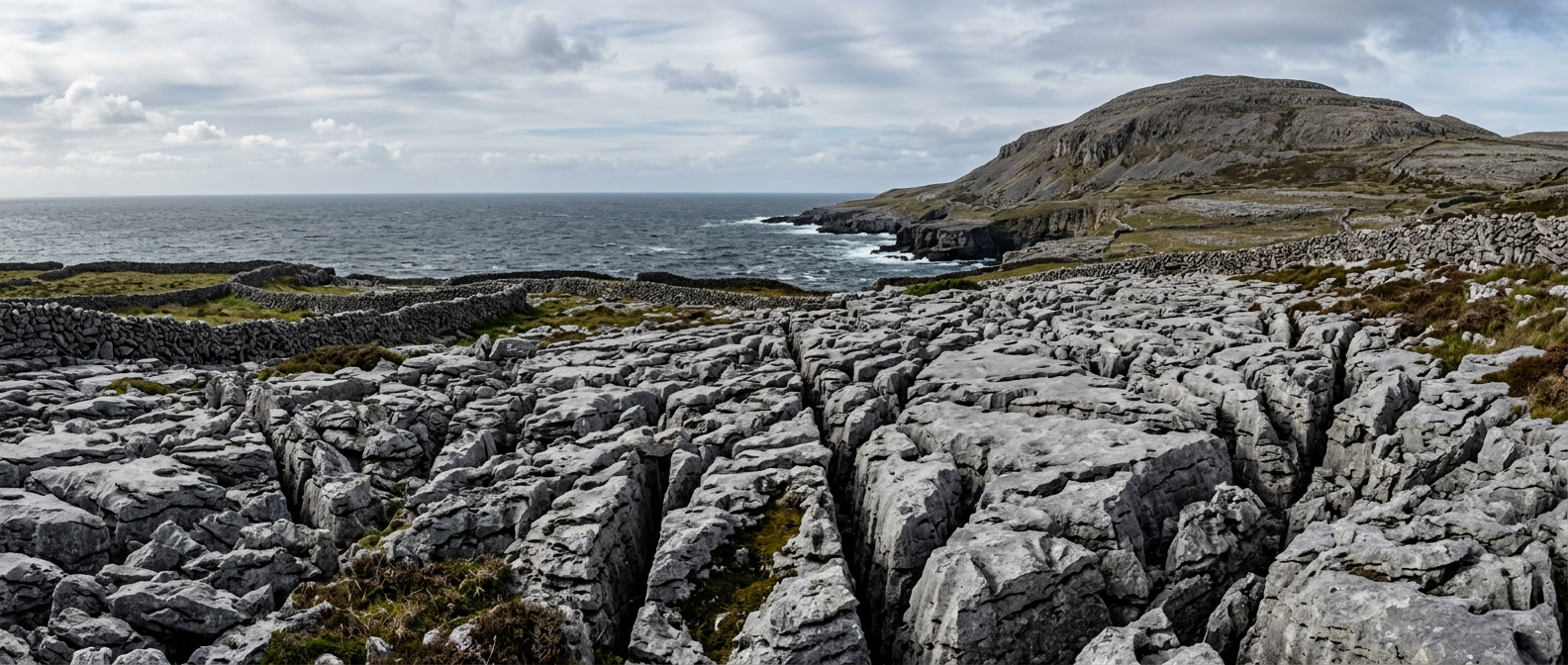
gray limestone, gentians in the cracks, cattle wintering uphill
Reserve seven nights in the Burren with a car
Seven nights in one village on the south shore of Galway Bay, a car outside the door for eight days, one morning on the limestone with a botanist and two dinner tables held, from $1,951 per person. The rest of the week is yours to spend as the sky tells you, and in this county the sky tells you by nine in the morning. Twenty minutes of driving puts you on bare rock that was the floor of a shallow sea 340 million years ago.
Send a booking requestThe Pine Gazette answers every request within one business day.
Reserve a seven night Burren trip with a car in County Clare and four things get held for you: one room in one village for the whole week, a car from the counter at Shannon for eight days, a morning on the limestone with a botanist, and two dinner tables. Nothing else goes into the reservation, because on this ground nothing else has to.
The Burren covers roughly a hundred square miles, and that number is what the week is built on. From a village on the south shore of Galway Bay you are twenty minutes from the portal tomb, twelve from a roofless Cistercian church standing in a valley with no houses in it, forty from the cliffs, and an hour from the hazel and rock of the national park. Everything is a there and back. You sleep on Thursday in the bed you slept in on Saturday, the bags stay open on the floor, and the day gets chosen at breakfast by looking out the window at the bay.
Loose days exist because of the weather. The Atlantic pushes four kinds of it through in an afternoon, and a morning of rain going sideways often gives up by two o'clock. People who fix an itinerary here spend the week keeping to it in the wrong conditions. People with keys and no plan drive to the sheltered side instead, which is usually the inland valleys around Carran, and walk in the dry.
The office books the base, the car and the one or two things that have to be held ahead. The days themselves are empty.
No rung is better than another. Each one is a different amount of work for the traveller and a different figure.
This is rung four of five, and it is not a thinned out version of rung one. A guided week and an unguided week are different trips that fail in different ways. The guided week fails when you wanted an hour to yourself and the coach was leaving. This one fails when nobody in the car is willing to make the call. Pick by which of those two you would mind more, not by how much is included.
- What it costs
- 7 nights, from $1,951 per person. Two sharing.
- What this reserves
- The office holds the room for all seven nights, the car for eight days, the botanist morning and the two dinner tables, and it holds nothing else: no day plans, no entry tickets, no boat and no air ticket.
- Shape of the booking
- One reservation: a double room held for seven nights, a compact automatic car for eight days, one guided morning on foot and two tables at half past seven, with nothing moving between beds and nobody meeting you at arrivals.
- Who books it
- Somebody booking this wants a bed that stays put and a set of car keys, and wants to decide at the breakfast table whether the day belongs to the coast road or the high pavement.
- Why somebody chooses another rung
- If you would rather be told where to stand at ten and driven there, the guided rungs do that work for you; if you want only a room and intend to find your own car and your own table, rung five is the one to take.
- In the figure
- Seven nights for two in one room in a village guesthouse, the same room the whole week; breakfast cooked to order each morning between eight and half past nine; a compact automatic car for eight days, unlimited miles, collected and left at Shannon; parking at the guesthouse for the length of the stay; a half morning on the limestone with a botanist who takes two people at a time, on a date fixed before you fly; two dinner tables in the village at half past seven, one on the night you land and one midweek; printed notes for six walks giving distance, climb in feet and where the ground turns to open fissure; a county road atlas and a marked sheet showing which turloughs are holding water in your week; a written line to the office in New Orleans for the length of the trip.
- Not in the figure
- Round trip air from the American South, $760 to $1,480 depending on the month; fuel for the week, $70 to $110 at roughly seven dollars a gallon; the motorway toll if you land at the far side of the country, $3 each way; lunches, $12 to $24 a head; dinner on the five nights not held, $28 to $65 a head; timed entry and parking at the cliff visitor point, $12 to $16 a head; the show cave and the walled ringfort on the plateau, $16 to $22 a head at each; the crossing to the island, which the company licensed to carry passengers sells and bills at the pier, $30 to $45 a head; a second named driver added at the rental counter, $45 to $70 for the week; one person alone in the room instead of two sharing, add $615.
- Who should not book it
- The roads decide this for most people: single lane for miles at a time, stone walls at the very edge of the tarmac, no shoulder to pull onto, blind bends on the hill, and everyone driving on the left. Walking the pavement means stepping across fissures four to eighteen inches wide with your ankles doing the work, and a knee that dislikes uneven ground will complain by the second hour. The village is quiet by ten at night, the shop shuts at six, the nearest pharmacy is eleven miles off, and evening entertainment is whatever somebody starts in a bar. Anyone who wants the week decided in advance, or who does not want to drive at all, belongs on another rung.
This is a starting figure, worked out for two people sharing a room. Costing the exact days you name runs two to four working days, since the firm operating the trip has to answer first. No air ticket is ever inside it.
Bare rock, and what lives in the cracks
The stone is full of crinoid stems and shell sections you can pick out with a fingernail. Ice took the soil off it and left pavement: flat blocks with fissures between them, some narrow enough to trap a boot, some deep enough that you cannot see the bottom. What grows down in those fissures is the reason botanists come. Spring gentian opens a blue that photographs badly from the last week of April into early June. Mountain avens flowers white beside it in May. A few feet away sits an orchid whose other populations are around the Mediterranean, and maidenhair fern grows down in the shade where frost does not reach.
The farming runs backward here and the flowers depend on it. Cattle are walked up onto the hills in October and brought down in April, which no other grazing system in Europe does. Bare limestone holds the day's heat and releases it overnight, the hilltops keep feed through the winter, and that winter grazing is what stops hazel scrub from closing over the flowers. Stand on a green road in late October and you will meet the cattle going up, and the man walking behind them will explain the whole arrangement if you stop the car.
Water behaves strangely on the way down. Rain sinks through the rock rather than running across it, so there are almost no streams, and in winter the hollows fill from underneath. The turlough below Carran covers something like a hundred acres in February and is a grazed grass hollow with a wall running across the middle by late June. Which of them still hold water during your week cannot be known in April, so it comes to you as a marked sheet a few days out rather than as a line in the paperwork.
The roads, and how long anything actually takes
Distances read short and drive long. Fifteen miles to the pier village in the southwest takes about thirty five minutes. The R480, which is the road the tomb sits on, is two lanes by designation and one lane in fact for long stretches, walls at the edge of the tarmac, passing places instead of a shoulder. Plan on averaging twenty five miles an hour and you will be close on most days.
The hill road out of the village climbs about 590 feet in a mile and a half through five hairpins, cut in the 1840s as relief work, and it is the quick way south over the tops. When the wind runs above forty miles an hour the coast road under Black Head takes spray across the tarmac at high tide; the inland road costs fifteen extra minutes and takes none. Fuel runs around seven dollars a gallon, and both pumps near the village close on Sunday evening, so the tank gets filled on Saturday.
The car is an automatic, and that has to be stated when the reservation goes in, because most of the fleet in Ireland is manual and the automatics run out first in June and July. It is reserved in the name of the person whose driving licence will be shown at the counter, spelled the way the licence spells it.
- March
- turloughs still full, hazel bare, sea about 48 degrees
- April
- cattle come down off the hills, first gentians in the last week
- May
- gentian and mountain avens on one slab, sixteen hours of daylight
- June
- magenta cranesbill across the pavement, light until close to ten
- July
- orchids gone over, cars queuing at the tomb between eleven and three
- August
- air around 66 degrees, sea about 59, rain on roughly thirteen days
- September
- traffic thins after the tenth, dry evenings, dark by half past eight
- October
- cattle walked back up onto the limestone, first Atlantic storms

Two bookings that will not hold themselves
The botanist morning runs three and a half hours and covers perhaps two miles, which tells you how much of it is spent standing still. It takes two people at a time, on one named date, and the handful of people who do this work in Clare have a season that runs from late April to early September. Where the route crosses grazed land the guide has a standing arrangement with the farmer, settled long before you land; where it runs into the national park it stays on ground open to anybody. Ask for it inside two weeks of your dates and you take whichever morning is left.
The dinners are simpler to explain and harder to get. The village restaurant that cooks properly seats twenty two at one sitting at half past seven, and by July it is taking bookings five and six weeks ahead. Two tables are held for you, the night you land and one midweek, because arriving after a nine hour flight and a fifty mile drive to find nothing serving after nine is the complaint this trip produces most. The other five nights you take what you find, which in practice means bar food until half past eight or twenty minutes of driving to a town with three kitchens open.
Plenty of people give one of the loose days to the island out in the mouth of the bay. The office does not sell that passage and cannot hold it for you. The company that carries passengers out there does so under its own licence, sets its own timetable, and takes the fare at the pier on its own account.
What the office holds, and who sends you a bill
The Pine Gazette is a booking office in New Orleans. It owns nothing on this page: not the room, not the car, not the table at half past seven, not the boat at the pier. Every one of those belongs to a company in Clare that runs it, and every one of those companies bills you itself, in its own name and on its own account. Pine Gazette Bookings LLC takes no payment at any stage, holds no card and operates no checkout.
No air ticket is sold here either. The long leg across the Atlantic stays yours to book, and the reservation is written around the dates you give rather than the other way round. Tell the office the day you expect to land at Shannon, the hour if you have it, and the day you fly home.
A price built against your actual dates comes back in two to four working days, because it means asking the guesthouse whether that one room is free for all seven nights rather than four, asking the rental company what is left in automatics, and asking the guide which mornings are still open. Send the dates and the number of travelers to bookings@thepinegazette.com, or call +1 (504) 832-6194 and give them out loud. Changes to a reservation already made go to corrections@thepinegazette.com. The office is at 2450 Severn Avenue, Suite 312, Metairie, LA 70001, in Louisiana, and the phone rings there.
Send a booking request
This form takes booking requests 24 hours a day. A person reads it and answers within one business day. Sending it is not a reservation, it costs nothing, and this office will not telephone or text you unless you ask it to.