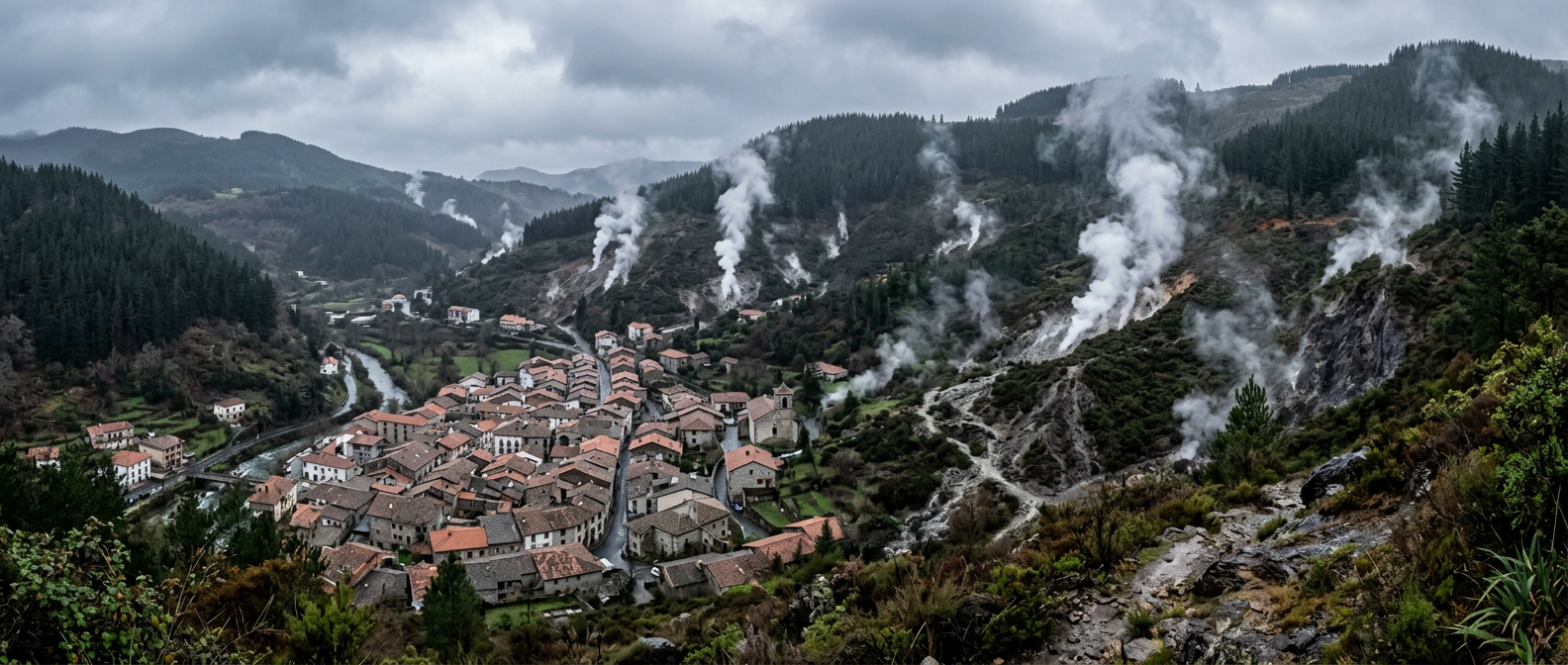
steam off the gutters at kannawa, breakfast at half past seven
Reserve a twelve night Kyushu hot spring trip, guided on four days
Twelve nights of rooms are held in eight hot spring towns, with a guide on four of the days and a seven day island rail pass for the other eight, from $4,574 per person on two sharing. The water in these towns leaves the ground between 50 and 98 degrees Celsius and is cooled, never heated, before anybody gets in. You go for that, and for the hour after dinner when the street is quiet and the tubs are still open.
Send a booking requestThe Pine Gazette answers every request within one business day.
Reserve a twelve night Kyushu hot spring trip and what you are holding is eight towns in one direction, from the east coast to the far south, with every room taken in your name before you leave home. The line starts at Beppu, where hot water is so much a part of the town's plumbing that on a January morning it comes up through gutters and around manhole lids. It finishes at Ibusuki, where you lie on a beach in a cotton robe and an attendant shovels black sand over you until only your head is out. In between you sleep at Yufuin, Kurokawa, Takachiho, Unzen, Hitoyoshi and Kagoshima.
Kyushu runs about two hundred miles from its north coast to its south, and the volcanic ridge down the middle is the reason every town on this list has water at all. Aso, halfway along, is a caldera with farmland and a railway inside the walls and a working crater at 1,506 meters that the prefecture closes to visitors whenever the sulfur dioxide reading crosses its threshold. Those closures are ordinary rather than rare. The guided day there is written so that it still stands up when the last kilometer of road is shut, which is why it is a guided day and not one of yours.
Rung two means a guide is beside you on four days and nobody is on the other eight. The rooms, the meals, all eight transfers and the rail pass are arranged in advance, so those days are not improvised, only unaccompanied. What you carry on them is a printed schedule, a pass in your own name and one number that answers in English.
A guide for the days that need one and nobody at all for the rest. Rooms and transfers are still arranged end to end.
No rung is better than another. Each one is a different amount of work for the traveller and a different figure.
- What it costs
- 12 nights, from $4,574 per person.
- What this reserves
- On this rung Pine Gazette Bookings LLC reserves the twelve rooms with their meals, the four guided days, all eight transfers and the rail pass, and it does not put anyone beside you on the remaining eight days or arrange a single thing you eat away from the inns.
- Shape of the booking
- The reservation is twelve nights across eight towns, one room a night for two, eight moves by rail or road, one crossing of Ariake Bay held by the company that runs the boat, and four mornings on which a guide is waiting at the door of the inn.
- Who books it
- Somebody reserving this wants the four awkward days handled and the rest of the twelve left alone, in a place where bathing runs on house rules and getting them wrong in front of a room of strangers is the part they would rather not risk.
- Why somebody chooses another rung
- The rung above keeps a guide beside you on all twelve days and never asks you to read a platform sign; the rungs below hold the eight rooms and hand you the timetable, the transfers and the whole of the caldera.
- In the figure
- Twelve nights in reserved rooms across eight towns, two sharing; dinner and breakfast on eleven of the twelve nights, served at fixed hours in the inns; a seven day rail pass on the island network, issued in your own name; all eight transfers between towns, by reserved rail seat or by the operator's road vehicle on the leg where the inland line is still out; four full guided days with an English speaking guide, at Beppu, on the Aso caldera, at Takachiho and on the Ebino plateau; the park permit for the caldera walk, filed by the operator the working day before; bath house entry on the guided days, including the round wooden pass in Kurokawa; one sand burial at Surigahama with the cotton robe and towel; luggage forwarded twice, so the large bags miss the two nights on the highlands; a telephone number answered in Japanese and English from 8 am to 9 pm on the eight days nobody is with you.
- Not in the figure
- The round trip flight from the American South to Fukuoka, which this office does not sell, $1,150 to $1,880 outside the New Year weeks and higher inside them; lunch on all twelve days, $8 to $22 a head; dinner on the one night in Kumamoto when the inn serves none, $18 to $40; bath house entry on the eight unguided days, 500 to 1,300 yen a person, so $4 to $9; the Ariake Bay crossing, which the company operating the boat holds under its own license and bills you for directly, $7 to $12 as a foot passenger; the thirty minute rowboat in Takachiho gorge, $22 to $30 a boat and reserved by time slot; coin laundry in the inns, $3 to $6 a load; drinks with dinner, $3 to $9 a glass; further luggage forwarding beyond the two legs above, $12 to $20 a bag; tipping, which is not expected anywhere on this line and is often refused.
- Who should not book it
- The bathing is communal, naked and single sex, you wash sitting on a stool before you go anywhere near the tub, and swimwear is not permitted in any bath on this line. Several houses along the Tanoharu and in Unzen refuse entry to visible tattoos of any size, and cover patches are accepted in some and not in others, so tell the office at the outset and rooms will be reserved accordingly. The Ebino plateau day covers about four miles with 700 feet of climb on volcanic grit at 1,200 meters, and the Takachiho gorge steps are wet all year. Inn corridors are unheated, rooms are entered without shoes, futons are laid on tatami at floor level, and the town outside goes quiet by nine.
This is a starting figure, worked out for two people sharing a room. Costing the exact days you name runs two to four working days, since the firm operating the trip has to answer first. No air ticket is ever inside it.
The water comes out too hot to sit in
Nothing on this line is warmed up. Every town here has the opposite problem. Beppu's springs surface between 60 and 98 degrees Celsius, which is 140 to 208 Fahrenheit, and the eight bathing districts each shed that heat their own way. Some run the water down long open wooden channels until it drops far enough to enter a tub. Some cut it with cold spring water. The houses that do neither leave a bamboo pole standing in the corner and expect you to stir before you climb in. A tub in Kannawa will sit near 43 degrees, about 109 Fahrenheit, and ten minutes is a long time in it.
The chemistry changes town by town and you notice it on your skin and on your jewelry. Beppu keeps several iron rich ponds standing at 98 degrees that are fenced because nobody bathes in them, one of them red with oxide. Unzen is sulfurous enough that inn notices ask for silver rings to come off before you get in. Kurokawa's water is milder and the town is organized around walking between houses: a round wooden pass costs about 1,500 yen, admits one person to three of the open air baths and stays good for six months if you do not spend it.
Ibusuki is the outlier. The heat under Surigahama holds the sand at 50 to 55 degrees at spade depth, an attendant covers you in roughly ninety seconds, and ten to fifteen minutes is the limit before you are dug out and sent to rinse. It is tidal, so the hour is set by the sea, and when the beach is under water the whole operation moves indoors to a shed of heated sand.
The four days a guide is with you
The first is Beppu on your second morning, walking the districts rather than riding between them, and it ends at a communal kitchen where vent boxes hold steam at 98 degrees and eggs take ten minutes, sweet potato closer to twenty five. You do the timing yourself with a kitchen clock on the wall.
The second is the caldera. The permit for the walk is filed by the operator the working day before, the rim is the first thing dropped when the gas reading rises, and the day is built to hold either way: the grassland at Kusasenri, the crater lakes if they are open, and the shrine at the north of the caldera whose tower gate was crushed in the 2016 earthquake and stood behind scaffolding until it reopened in December 2023.
The third is Takachiho, which needs a guide for a plain reason: the gorge boats go by reserved half hour slot, the last one leaves the water in the late afternoon, and the night kagura at the shrine begins at eight, runs about an hour and takes four of the thirty three dances in rotation. You sit on the floor for it. Getting all three into one day without somebody who knows the order is how people miss two of them.
The fourth is the Ebino plateau in the Kirishima range, a loop of about four miles past three crater lakes with 700 feet of climb, under a peak of 1,700 meters, with a restricted radius around the vent that moves when the volcanic level moves.
One more day is driven rather than guided. The inland railway between the Kuma valley and the south coast has been out since the flood of July 2020 and is not expected back for years, so the leg into Hitoyoshi runs by road in the operator's vehicle and takes about two hours and forty minutes.
- January
- Kurokawa sits between 1 and 7 C, snow falls on a handful of days, and bamboo lanterns line the Tanoharu after dark from late December
- March
- Daylight passes twelve hours mid month; cherry opens in Kagoshima in the last week and reaches the caldera rim about two weeks later
- May
- The dry stretch before the rains, 22 to 25 C, and the azalea on the Ebino plateau is out for roughly ten days at the end of it
- Mid June to mid July
- The rains, and this island takes them harder than most of the country; the plateau can log 400 millimeters in June and mountain roads shut after the heavy nights
- August
- 32 to 34 C with humidity to match; sand burials at Surigahama are worked early and after five, and the walking days are cut short
- September
- Typhoon season at its peak; a track across the island moves trains rather than rooms, and the day is rebuilt on the morning
- October
- 24 C at noon and 14 at night, about 90 millimeters of rain in the month, sunset near a quarter to six
- December
- Sunset at 5:19 pm in Kagoshima and full dark by six; the outdoor tubs run against air at 4 degrees and the steam never clears
Dinner at half past six and the door at eleven
Eleven of the twelve nights are in houses that serve both meals, and the hours are theirs. Dinner is put in front of you at half past six in most of them and seven in the rest, in a room set for you, and it is not held for a late train. Breakfast is at half past seven, grilled fish and rice and a raw egg you may or may not want. While you are in the bath somebody lays the futons. Several of these houses lock the front door at eleven and hand you a code rather than a key.
You wear the cotton robe supplied, to dinner and out into the street, and in Kurokawa and Yufuin so does everyone else. Shoes come off in the entry hall and stay off. Corridors are not heated and in January that is noticeable between the room and the bath at six in the morning, which is the hour worth being awake for, because the outdoor tubs are empty then and the air over the river is four degrees.
The one night without meals is Kumamoto, where the covered arcades run for several blocks and eating out is the point of stopping.
Holding twelve dated nights in eight towns
Tell Pine Gazette Bookings LLC the month, the two dates you can move between and how many of you there are, and the work of costing twelve specific nights and putting the figure on paper takes two to four working days. Rooms in Kurokawa and Yufuin go a long way ahead for the leaf weeks of late November and for the New Year, and eleven of these twelve nights are in houses under twenty rooms, so early dates mean fewer substitutions.
This office keeps no rooms, no vehicles and no boats of its own. Every night, every guided day and the water crossing of Ariake Bay belong to the companies that operate them, and each of those writes its own contract and bills you under it. Nothing is paid to us at any point, in any form. The operator's cancellation terms arrive in writing with the figure, and you read them before you agree to anything.
The flight is yours. No airfare is sold from this office, so reaching Fukuoka is arranged by you, and the schedule is written around the arrival you tell us about rather than the other way round.
You can reserve by the form below, by writing to bookings@thepinegazette.com, or by calling +1 (504) 832-6194. The office is at 2450 Severn Avenue, Suite 312, Metairie, LA 70001, and Pine Gazette Bookings LLC is registered in Louisiana. If a figure or an opening hour here has gone out of date, send it to corrections@thepinegazette.com, and if you would rather talk it through, somebody in New Orleans answers the phone.
Send a booking request
This form takes booking requests 24 hours a day. A person reads it and answers within one business day. Sending it is not a reservation, it costs nothing, and this office will not telephone or text you unless you ask it to.