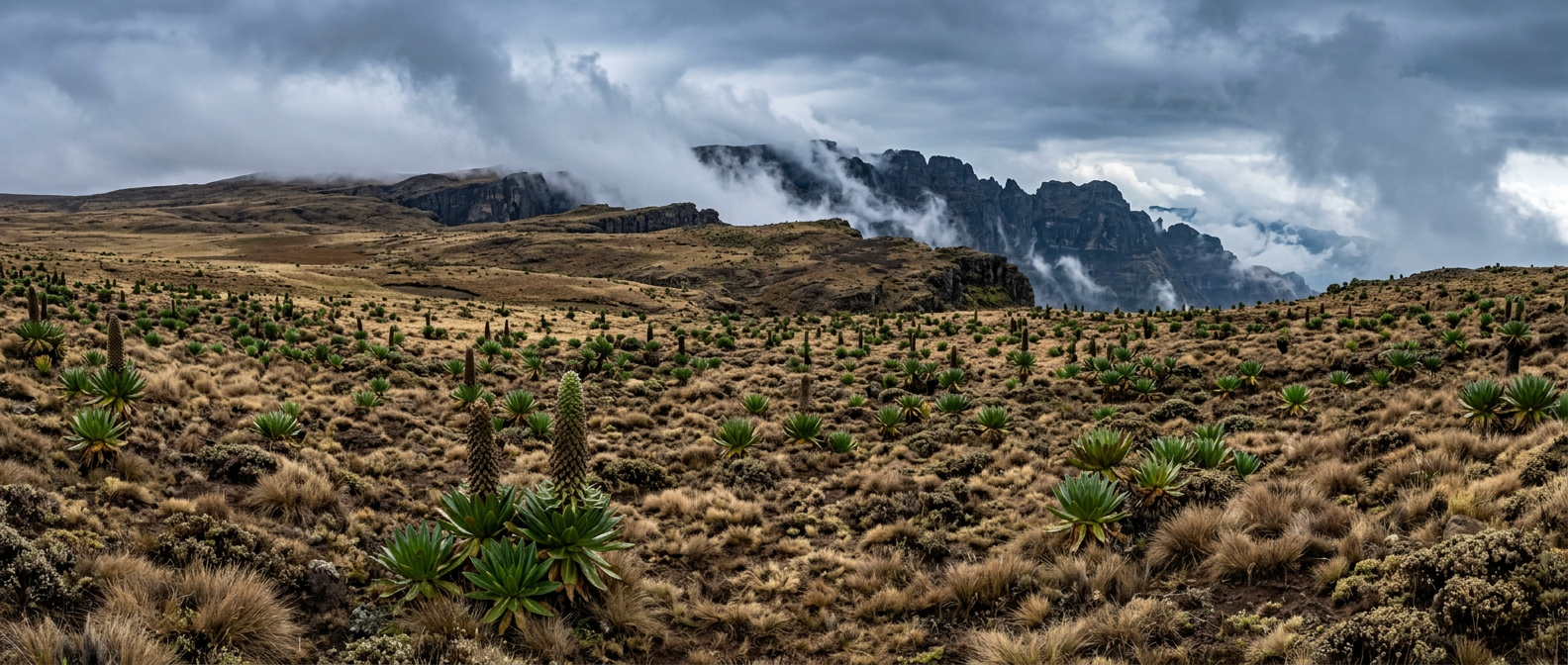
ground frost at dawn, wild coffee under a wet canopy by dusk
Reserve eleven nights in the Bale Mountains of Ethiopia
Eleven nights are held across the Bale massif for $5,429 per person, two people sharing a room: two at Dinsho, four in Goba, three in the forest camp above Rira and two in Addis Ababa, with a guide and a driver on every one of the days between. You go up onto the Sanetti plateau for the wolves and the frost, then down 6,600 feet through the escarpment cloud into a forest where coffee grows on its own. The park entry and the scout are arranged before you land.
Send a booking requestThe Pine Gazette answers every request within one business day.
Eleven nights in the Bale Mountains split cleanly in two. The first half sits above the tree line on the Sanetti plateau, where the ground freezes on most nights of the year and the inside of the vehicle glass ices over before dawn. The second half drops off the southern rim into the Harenna forest, where the canopy closes over the road and coffee grows in the shade without anybody having planted it. You do both in one vehicle, on one road, with the same guide and the same driver, and the change from one to the other takes about four hours of driving.
The office holds the ground portion before you leave home: rooms, vehicle, driver, guide, park entry for every day inside the boundary, the scout who has to ride in any vehicle within it, and the two long transfer days at either end. Reaching the country is yours to arrange, and no air ticket is sold at this counter. You land at Addis Ababa, and somebody is standing with your name on a card when you come out of the hall.
What makes this trip hard is altitude and road surface, and both are worth saying before you decide anything. Goba, where you sleep four of the eleven nights, stands at about 8,900 feet. The plateau road crosses above 13,900 feet, and a rough spur climbs off it to the mast on Tullu Dimtu at 14,360 feet, the second highest point in the country. Most people notice the last thousand feet in their chest and in how they sleep.
Somebody is waiting at arrival, a guide is with the party most days, and every transfer and entry is held in advance.
No rung is better than another. Each one is a different amount of work for the traveller and a different figure.
- What it costs
- 11 nights, from $5,429 per person.
- What this reserves
- On this rung the office books the rooms, the vehicle and its driver, the guide for all eleven days, the park entries, the scout and the meals listed below, and it does not book the flight, the phone card or anything you decide to add once you are on the ground.
- Shape of the booking
- The reservation is eleven nights across four addresses, two at Dinsho, four in Goba, three under canvas above Rira and two in Addis Ababa, with one room, one vehicle, one guide and one driver held for the whole of it.
- Who books it
- Somebody who wants the plateau at first light with a person beside them who knows which valley the wolves worked yesterday, and who has no interest in arguing over a vehicle in Goba at half past six in the morning.
- Why somebody chooses another rung
- If you would rather set your own hours and eat when it suits you, a rung further along this ladder buys the beds and the permits and leaves the eleven days to you.
- In the figure
- eleven nights of rooms as listed, two people sharing; all ground transport in one four wheel drive vehicle with its driver; an English speaking mountain guide on all eleven days; park entry for every day inside the boundary, obtained by the operating company in advance; the park scout who has to ride with any vehicle inside the park; the camp fee at Rira with tent, mattress and bedding; breakfast on all eleven mornings and dinner on the nine nights outside Addis Ababa; a packed lunch on the six full days in the park; six liters of drinking water per person per day in the vehicle; the pickup and the drop at the airport in Addis Ababa.
- Not in the figure
- the flight to Addis Ababa and back, which from the American South runs $1,050 to $1,780 round trip depending on the month; lunch and dinner on the two Addis Ababa nights, $12 to $35 a head; drinks of any kind, $2 to $6 a bottle; tips for the guide, driver and scout, $180 to $280 a person across the eleven days; a horse and a handler for the walk out to the Web valley rim, $25 to $40 a day; the Sof Omar cave day if you add it, $20 to $35 a person for entry and the local guide; laundry at the Goba guesthouse, $2 to $4 an item; a local phone card with data, $8 to $20 for the trip; the single room supplement, $610 for the eleven nights; cold weather clothing you do not already own, $80 to $250.
- Who should not book it
- Six of the eleven days sit between 10,000 and 14,360 feet and on the plateau days there is no lower ground to drop back to before evening. Anybody who cannot sit in a vehicle on a broken surface for five or six hours at a stretch, or who needs a bathroom on a schedule, will have a poor time of it, because there is nothing at all between Goba and Rira. The forest camp is a tent on a mattress with a bucket shower, and the generator stops at ten; the nearest fuel and the nearest mobile signal are two hours back up the escarpment. If quiet gets to you, the plateau is very quiet, and on a normal day you will pass three or four other vehicles in seven hours.
This is a starting figure, worked out for two people sharing a room. Costing the exact days you name runs two to four working days, since the firm operating the trip has to answer first. No air ticket is ever inside it.
The road out of Goba and onto Sanetti
The climb out of Goba covers about 12 miles and gains 4,500 feet. The first band is tree heath, six to twenty feet high, hung with pale lichen and blackened in patches where the grazing fires ran through. Somewhere above 11,500 feet the heath stops and the moorland starts, and that change happens over a few hundred yards rather than a few miles.
Then there is the ground itself. Freeze and thaw work it more than two hundred nights a year, so the plateau is pushed up into hummocks with sedge on the crowns and standing water in the troughs after rain. Giant lobelia grows between them, a single rosette of stiff leaves that stays low for ten years or more and then sends up a flowering column eight to twenty feet high, seeds once and dies where it stands. There are more than forty small lakes up there. Garba Guracha lies at about 12,960 feet in a rock bowl that held ice fourteen thousand years ago, and the moraine that dammed it is still a clear ridge across the outflow.
Hail arrives in the afternoon, usually between two and four, and it comes in fifteen minute bursts rather than settling in for the day. The crossing from Goba to the forest side is roughly 65 miles and takes four hours, not because the distance is long but because the surface is broken and because you will keep stopping.
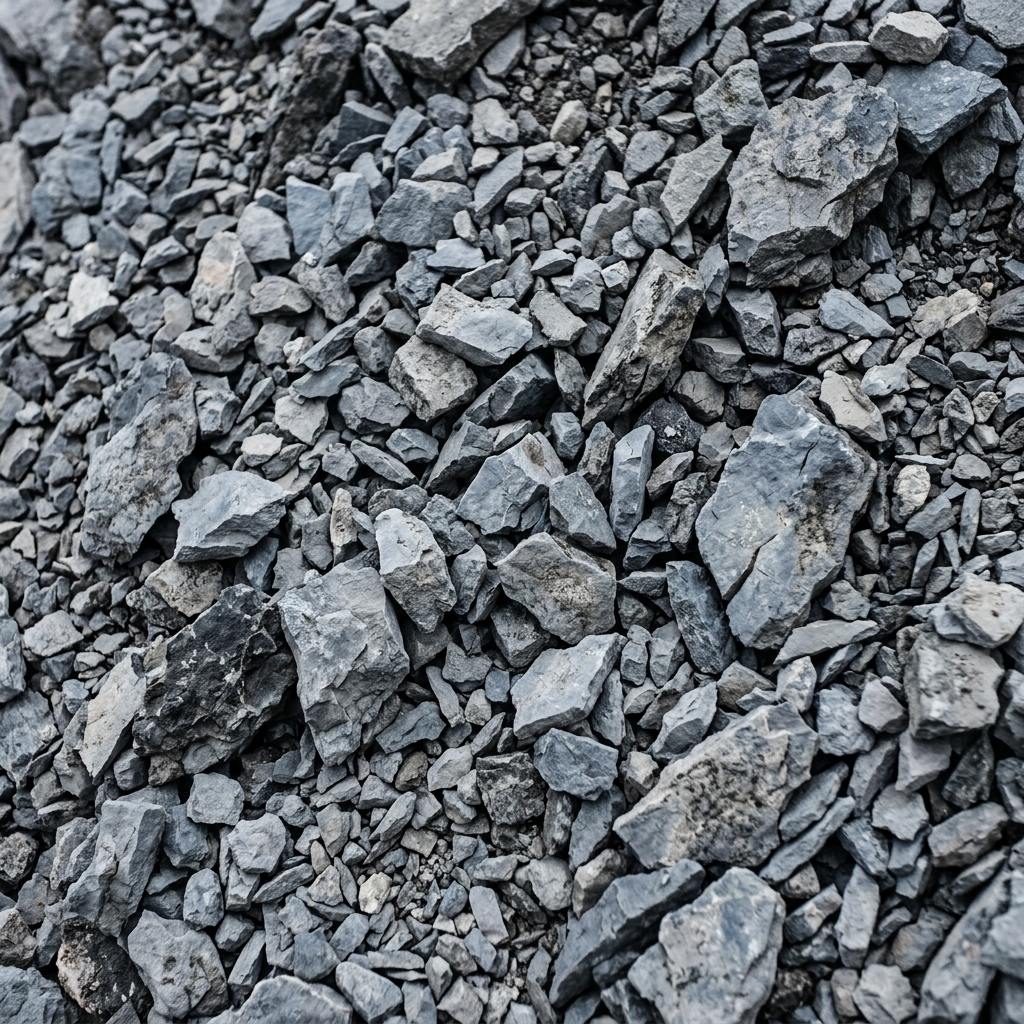
What lives up there, and the hours it shows itself
Fewer than five hundred Ethiopian wolves are left, and about half of them use this plateau and the Web valley next to it. They are rust and white, built like a lean coyote, and they hunt alone in daylight instead of running the prey down as a pack, walking the hummocks and listening for rodents underneath. The pack only comes together twice a day, at first light and again in the last hour before dark, to greet each other loudly and then split up again. The animal they mostly eat, the giant molerat, exists on this massif and nowhere else; it pushes a plug of soil out of its burrow and then sits with the top half of its body out of the hole, which is exactly why a wolf can make a living at 13,000 feet.
Lower down at Dinsho, in woodland of hagenia and juniper at about 10,000 feet, mountain nyala browse at first light. Something near four thousand of them are left and this is where most of them are. Overhead the bearded vulture works the escarpment edge on a wingspan close to nine feet and drops bone onto rock to get at the marrow. On the wet flats you get wattled crane, spot-breasted lapwing, and the blue-winged goose, which breeds on this highland and on no other.
Your guide is out with you for the two windows that are worth anything, roughly 6:30 to 9:30 in the morning and 4:00 to 6:30 in the afternoon. The middle of the day is for driving, eating and sitting down.
- November to January
- dry and cold, ground frost on most nights, clear mornings, wolf sightings at their steadiest
- February
- dry, dust on the Goba road, haze off the lowlands by afternoon
- March to May
- short rains, green moorland, lobelia in flower, hail on Sanetti most afternoons
- June
- changeable, the escarpment road slick in patches, very few other vehicles
- July to September
- main rains, up to fourteen inches a month on the southern slopes, water standing on the forest road for days
- October
- rains easing, forest at its wettest underfoot, mushrooms and leeches in the Harenna
- Any month
- sunrise between 6:20 and 6:45, sunset between 6:25 and 6:55, day length moving under an hour across the year
- Any month
- plateau nights between 23 and 30 degrees, plateau days between 45 and 60
Down the escarpment into the Harenna forest
From the southern rim the road falls from about 11,500 feet to 4,900 feet in some 25 miles of switchbacks, and the vegetation changes every thousand feet of it. Cloud sits on the rim most mornings and the road runs straight through it for twenty minutes. Rira, where you sleep three nights, is at about 7,900 feet, and the camp there is a clearing with permanent tents, mattresses, a long table and a cook working on gas bottles. Dinner is at seven because the generator runs from six to ten and not after it.
Arabica coffee grows under this canopy on its own, which is true of very few forests anywhere, and the villages pick it in November and December and dry it on raised beds beside the road. Beekeepers hang log hives thirty and forty feet up in the crowns and climb to them on a loop of rope. The Bale monkey lives on highland bamboo and has a range of a few hundred square miles, nearly all of it within a day of this camp. Colobus move along the top of the canopy in the first hour of light. There are leopard tracks in the mud of the road most weeks and almost nobody sees the animal that made them.
At night the tree hyrax starts up, a rising series of creaks that ends in a scream, and it will wake you the first time it happens. Rain here mostly falls between midnight and four in the morning, which is why the mornings work.
How the eleven days are laid out
Two of the eleven nights go on getting there and back. Addis Ababa to Dinsho is about 250 miles of tarmac and roadworks, eight to nine hours with a stop for lunch, and the same again in reverse at the end. Four nights are in a guesthouse in Goba with hot water in the evening only. Two are at the park headquarters end at Dinsho, and three are under canvas in the forest. One vehicle and the same two people, guide and driver, stay with you from the first morning to the last.
If you want the cave day at Sof Omar, where the Weyib River runs into nine miles of limestone passage and comes out the far side, it goes in as a long out and back from Goba, and it is 240 miles of driving for one afternoon underground. Ask for it early, because it decides which nights sit where.
Nothing on this page belongs to this office. Not the vehicle, not one bed, not the camp. The company that runs the eleven days holds the licences for the ground it covers, signs its own contract with you and sends you its own invoice; no money changes hands here at any stage of it.
Naming your actual dates and getting a firm figure back takes two to four working days, because the park office has to confirm the scout and the camp space for those exact dates before anybody puts a number on paper. Rira fills for December and January well ahead, so an answer for a February departure comes back quicker than one for the last week of the year. The Pine Gazette is the name used by Pine Gazette Bookings LLC, whose office is at 2450 Severn Avenue, Suite 312, Metairie, LA 70001, in the New Orleans metro, a Louisiana agency that books and does not operate. Send the dates and the number of people to bookings@thepinegazette.com, or call +1 (504) 832-6194 and talk it through. Anything on this page that reads wrong to you should go to corrections@thepinegazette.com.
Send a booking request
This form takes booking requests 24 hours a day. A person reads it and answers within one business day. Sending it is not a reservation, it costs nothing, and this office will not telephone or text you unless you ask it to.