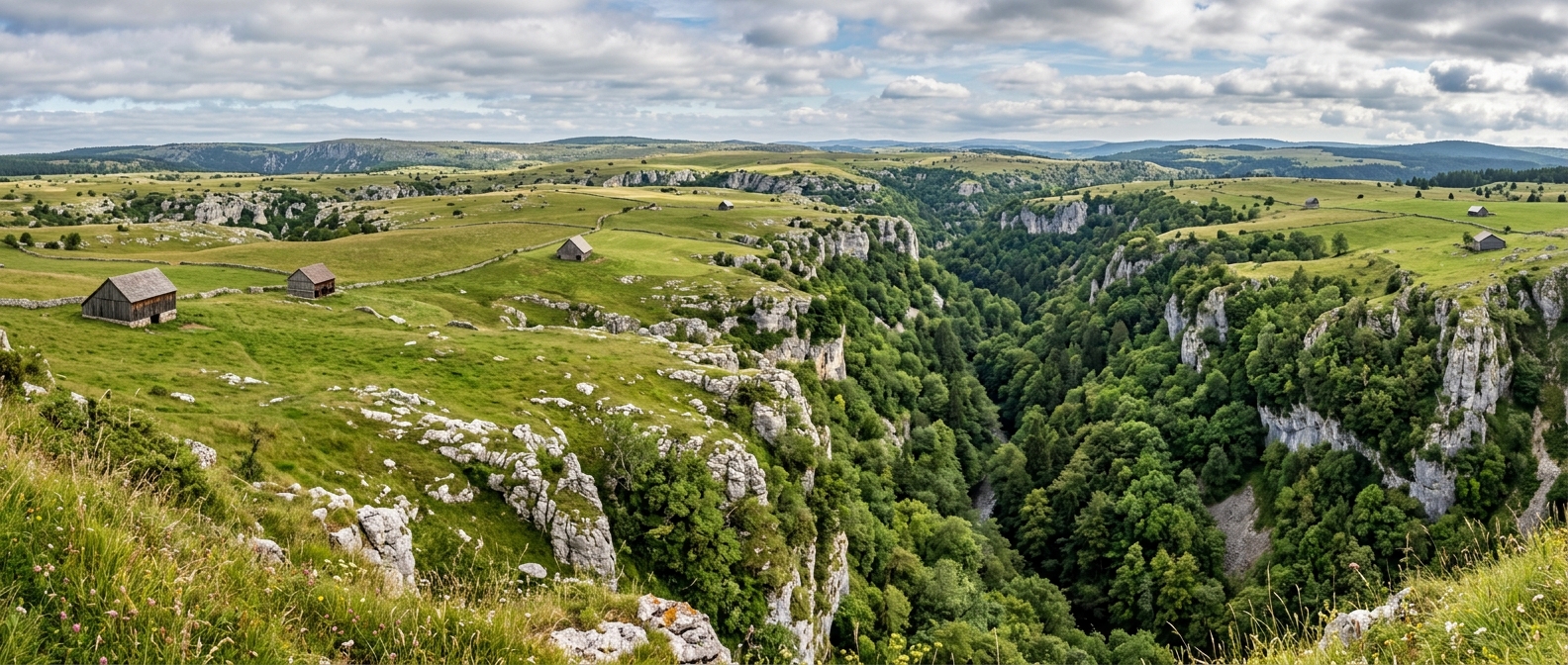
ice underfoot in august, wood smoke, gravel above the beech line
Reserve nine nights in the Apuseni, western Romania
We reserve nine nights in the Apuseni for two people sharing, from $3,661 each, with a caving guide on four of the days and a small car under you for all nine. The range is limestone the whole way down, so the interesting part of it is underneath: one cave holds an ice body that does not go in summer, and a river runs 850 feet through a hillside with five holes broken in the ceiling. The hamlets on top sit on grazed grass at 3,800 feet with gravel between them.
Send a booking requestThe Pine Gazette answers every request within one business day.
A nine night Apuseni trip reserved through this office puts a guide with you on the four days that go underground and nobody at all on the other five. The range sits in the western arm of the Carpathians, between the Crișul Repede and the Arieș, and it does not look like the Carpathians most people picture. There is no single high ridge to walk. There is limestone, roughly 1,500 caves inside it, and rivers that spend part of their length below the grass.
The Someșul Cald is the plainest example of what that means. It goes into a hillside at Rădesei and comes out about 850 feet later through a corridor with five holes broken through the ceiling. Stand in the streambed around midday in July and five separate columns of light land on the water in front of you, each one shifting as the sun moves. You walk in from the downstream end in the same boots you drove in wearing, and the whole thing takes forty minutes.
Above all of this the ground is grass, beech and fir, and the villages are not villages in the ordinary sense. A crâng is a hamlet of houses set out singly across a hillside, each with its own hay, its own spring and a quarter mile between it and the next roof. Ghețari sits at about 3,770 feet directly over the ice cave, which is the only reason there is a settlement that high.
A guide for the days that need one and nobody at all for the rest. Rooms and transfers are still arranged end to end.
No rung is better than another. Each one is a different amount of work for the traveller and a different figure.
- What it costs
- 9 nights, from $3,661 per person.
- What this reserves
- The office books the three guesthouses, the four guided days, the two cave authorizations and the car, and it books none of your flight, your fuel, your dinners on the free days or anything you decide to do with them.
- Shape of the booking
- Three guesthouses across nine nights, two moves by road, one car held from the first afternoon to the tenth morning, four days with a guide and five without, and two written cave authorizations held in the operating company's name.
- Who books it
- Somebody booking this wants the underground days run by a person who does that for a living, and the rest of the week left completely alone.
- Why somebody chooses another rung
- If the thought of 14 miles of forest road in the dark after six hours in a gorge does not appeal, rung 1 puts a driver and a guide with you every morning of the nine instead.
- In the figure
- Nine nights in three family guesthouses, twin or double, private bathroom in each; breakfast every morning and dinner on the four guided days; a small car from the afternoon of day one to the morning of day ten, with unlimited mileage; four days with an English speaking caving guide; the written park authorization for the two closed cave sections, obtained by the operating company; entry to the show sections of both cave systems; helmet, lamp, harness and gloves for the two underground days; a 1:25,000 sheet of the Padiș plateau and a road book marked for the five free days; forest road and parking fees on the Padiș approach; a telephone number answered in Romanian and English across all nine days.
- Not in the figure
- Round trip flight from the American South to Cluj-Napoca or Oradea, roughly $980 to $1,680 depending on the month; fuel for about 435 miles of driving, $95 to $130; dinners on the five free days, $14 to $26 a head; lunches throughout, $7 to $15 a head; a third underground day added on request, $180 to $240 for the two of you; the tractor shuttle if snow shuts the last two miles to the plateau house, $40 to $70 per party; entry to the show cave at Meziad if you add it on a free day, about $6 a head; laundry at the Arieș valley guesthouse, $8 to $12 a load; anything you buy in the village shops, which take cash only, $20 to $60 over the week; tips to the guide, yours to set, commonly $40 to $80 across four days.
- Who should not book it
- Do not book this if you cannot go down 157 feet of wooden staircase and come back up it twice in one day, because there is no other way into Scărișoara and no shorter version once you are on the ice. The gorge day is six hours, twelve fixed ladders, a cabled traverse with your boots in the water for stretches, and 2,300 feet of climb that you do at the end rather than the start. Two of the nine nights are 14 miles up a gravel road with one bar of signal, no shop and dinner served at seven or not served, and the houses up there have stairs and wood stoves and nothing else. If sitting for four hours on a hillside where the only sound is a bell on a cow bores you, five unguided days will be a long time.
This is a starting figure, worked out for two people sharing a room. Costing the exact days you name runs two to four working days, since the firm operating the trip has to answer first. No air ticket is ever inside it.
The ice at Ghețari holds all summer
Scărișoara is entered through a shaft 157 feet deep and roughly 200 feet across, down a wooden staircase bolted to the rock face. The meadow at the top can be 75 degrees in July. Twenty feet down the warmth has already gone, and in the great hall the air sits within a degree of freezing on every day of the year. The ice under your feet runs to something like 3.5 million cubic feet and is up to 74 feet thick, laid down in visible layers with dark organic bands between them, and it is the reason anybody drives up that road at all.
The show route is a railed platform and a viewpoint over the hall. Two sections past it, the large lower reservation and a side gallery, are closed to general entry and need a written park authorization and a guide who holds the right caving qualification. The operating company holds that authorization and renews it each season, and the fee for the two of you is inside the figure on this page. Those sections are floor ice, wet and smooth, worked on a rope with a helmet and a lamp, and you are down there about ninety minutes at 32 degrees. Gloves and a fleece in August are not a suggestion, and the first time is when people learn that.
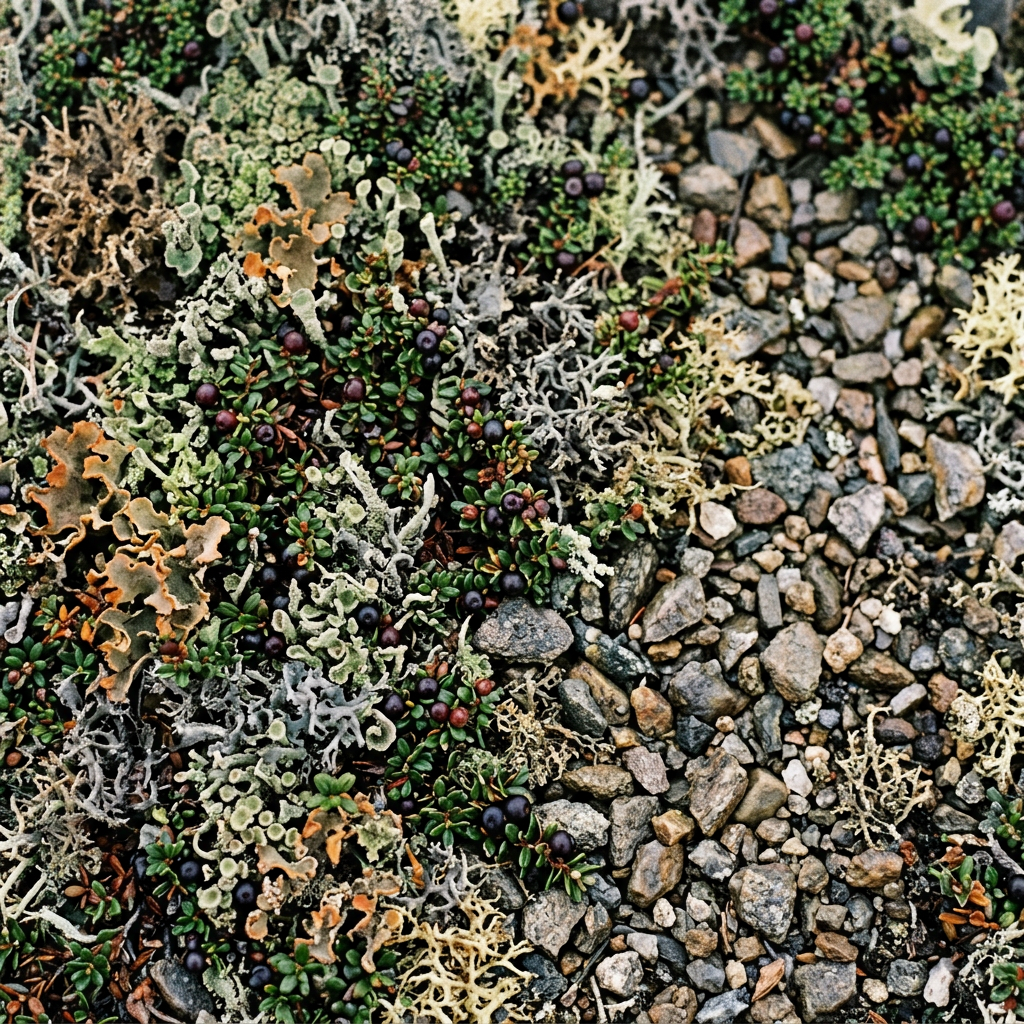
Four days with a guide, five days with a map
Day two is Scărișoara and the closed gallery. Day four is the Padiș plateau on foot: the belvedere above Cetățile Ponorului, then forty five minutes down a root and mud path to the floor of the first collapse, where the portal stands 250 feet over your head and the stream that cut it carries on into the dark. Day six is Focul Viu, a smaller ice block lit through a hole in a fallen roof, timed for the hour either side of noon when the shaft of light actually reaches it. Day eight is the Galbena gorge: six hours, twelve fixed ladders, a run of cable with the water at your ankles, and 2,300 feet of climb on the way out.
Between those the party has the car, the map and a telephone number. The five free days are the whole point of this rung rather than the one above it. Nobody knocks at eight in the morning. If you want to spend a Tuesday sitting outside a sheepfold above Gârda watching a man turn curd in a copper pot, nobody has an opinion about that Tuesday. The road book marks the red erosion ravine at Groapa Ruginoasă, about a thousand feet across and still moving, the basalt columns at Detunata Goală an hour and a half east, and four horizontal water mills that still grind on the Crișul Negru side.
- May
- Padiș forest road often still shut by snow above 3,700 feet, meltwater across the tracks below Ghețari, caves open and the plateau usually not
- June
- Light from about 05:35 to 21:15, grass to the knee, storms building after three in the afternoon roughly one day in three
- July
- Warmest weeks on the plateau, 68 to 75 degrees by day and 45 to 50 at night, while the ice hall stays at 32
- August
- Water low, the intermittent spring at Călugări can go quiet for weeks, flocks on the highest grazing, dust on the gravel
- September
- Beech turns from the valley floor upward, plateau nights down to 37 degrees, guesthouse dinners move half an hour earlier
- October
- First snow above 4,600 feet most years, the gorge ladders go slick, and the guide may swap that day for the long gallery at Meziad
- November to March
- Plateau road closed, Ghețari reached by one cleared lane, entry at the ice cave limited to the upper hall
- Late March to April
- Thaw, mud on every forest track, and two of the three guesthouses shut for the month
The road to Padiș and the six rooms at the end of it
You will drive about 435 miles across the nine days and around 60 of those are gravel. The approach to the plateau from the Pietroasa side is 14 miles of forest road that takes an hour and a half in a small car, with two fords that run after rain and a surface that has been patched with river stone rather than asphalt. The DN75 through Gârda de Sus and Arieșeni is paved and slow, with sheep on it at both ends of the day and log trucks in the middle of it. Dogs come out to the road at every fold. Cluj-Napoca is about 80 miles from the first guesthouse and takes three hours.
The three houses have six to nine rooms each. Heat is a wood stove in the room and a tiled stove in the hall. Hot water comes off a boiler that gets lit in the afternoon, so a shower at six is a different experience from a shower at eleven. Dinner is at seven or it is not, because the woman cooking it also has cows to bring in, and the nearest shop to the plateau house is 11 miles back down the gravel. Signal on the plateau is one bar in three places, and you learn where they are by the second day.
Who runs the nine days and who sends you the bill
Pine Gazette Bookings LLC is a booking office at 2450 Severn Avenue, Suite 312, Metairie, LA 70001, in the New Orleans metro of Louisiana, and nothing that carries or sleeps a traveler on this page belongs to it. The rooms belong to three families in Gârda, on the plateau and in the Arieș valley. The car belongs to a rental firm in Cluj. The guiding, the ropes and the park authorization belong to a Romanian company with its own caving qualification, and that company invoices you directly under its own contract in its own currency. We handle no money at any point in this, and there is nothing to pay here.
Getting yourself to Romania is your own arrangement. The Pine Gazette does not sell airfare and holds no seats on anything that flies. What we do is take the dates you name and put a firm figure against them, which runs two to four working days, because two of the three guesthouses answer the telephone in the evening after milking and not before, and the guiding company confirms the authorization dates separately.
Tell us the month and the two or three date windows you can actually travel in, on +1 (504) 832-6194 or by mail at bookings@thepinegazette.com, and say whether the gorge day is in or out, because that one decision changes the shape of the week more than anything else on the sheet. If something on this page reads wrong to you or has gone stale, corrections@thepinegazette.com reaches the person who keeps it current.
Send a booking request
This form takes booking requests 24 hours a day. A person reads it and answers within one business day. Sending it is not a reservation, it costs nothing, and this office will not telephone or text you unless you ask it to.